

Finalists announced for CJF Dr. Eric Jackman Awards for Excellence in Journalism
TORONTO, April 17, 2026 – The Canadian Journalism Foundation (CJF) is proud to announce its shortlists for the CJF Dr. Eric Jackman Awards for Excellence in Journalism, honouring news organizations that embody exemplary journalism and have a profound positive impact on the communities they serve. Finalists are recognized in two categories: large and small media.
Through this prestigious award, the CJF has since 1996 recognized news organizations that embrace ideals of journalistic excellence – originality, courage, independence, accuracy, social responsibility, accountability and diversity.
“Last year, Canadian news organizations produced stories that affected communities across the country, from distinctive municipal election coverage to exposing the impact of online threats and criminal activity,” says jury chair Christopher Waddell, professor emeritus at Carleton University’s School of Journalism and Communication. “It is particularly encouraging to see the growing number of strong entries from relatively new online news organizations – some self-produced and others produced in partnership with some of Canada’s best-known media outlets. The awards provide an opportunity to recognize and celebrate the benefits for audiences generated by this changing landscape and evolution of Canadian media.”
The five finalists in the large media category (more than 50 full-time editorial employees) and the stories and/or series shortlisted for the award are:
- APTN Investigates for Secrets of the Bay, a two-year investigative documentary series by reporter Kenneth Jackson, with Josh Grummett, Cullen Crozier, Steve Mongeau, Joseph Saunders, John Cooke, Tom Fennario, Brendan Hennigan, Paul Barnsley and Cheryl McKenzie, examining the 2015 drowning deaths of Tyler Maracle and Matthew Fairman in Tyendinaga Mohawk Territory near Belleville, Ont. The reporting centres the experiences of the families while rigorously testing official conclusions, and, in 2025, led to the coroner changing the manner of death and the Toronto Police homicide unit taking over the investigation.
- The Canadian Press (CP), for Inside the Ring of Fire: A tale of two First Nations and a road that could change everything. Reporter Liam Casey and photographer Chris Katsarov-Luna visited two fly-in First Nations and captured visuals of a mining camp that is the impetus behind road-building projects, then flew to a riverside encampment that seeks to block the projects’ construction. Their reporting, with contributions from the CP team, offered a rare glimpse of day-to-day life in a region on the cusp of transformations wrought by climate change and the pursuit of the coveted mineral wealth below.
- CBC News – The Fifth Estate, for its series Exposing 764: On the trail of an extremist “cult” of online predators, tracking a global network of online predators, many of whom are teenagers. The team, consisting of Ioanna Roumeliotis, Laurence Mathieu-Leger, Andrew Culbert, Mariel Borelli, Ousama Farag, Roxanna Woloshyn, Allya Davidson and Emmanuel Marchand, tracked down a Canadian survivor of the online cult and convinced Trinity and her mother to share details of their ordeal publicly on camera for the first time.
- Le Devoir for L’indomptable Mammouth, a journalistic project of exceptional scope, tracing more than half a century of reforms to Quebec’s health-care system – from the creation of public health insurance in 1970 to the establishment of Santé Québec in 2024. Incursion au cœur du mammouth de la santé, produced by parliamentary correspondent Marie-Michèle Sioui and former political adviser Pascal Mailhot, stands out for its privileged access behind the scenes of power. Additional contributors include Guillaume Levasseur, Julien Forest, Cédric Gagnon, Laurence Thibault, Jasmine Legendre and Helena Cauvet.
- W5/CTV News for Sleeping with the Enemy, an explosive investigation exposing a world of misogynistic criminality being secretly perpetrated by men against the women they claim to love. Undercover for months, W5’s Avery Haines with support from team members Jerry Vienneau, Angelo Altomare and Joseph Loiero infiltrated a network of men who drug, rape and videotape their intimate partners, exposing the international and inter-connected nature of the network.
The five finalists in the small media category (fewer than 50 full-time editorial employees) and the stories and/or series shortlisted for the award are:
- The Green Line for a three-part reporting series examining how the Eglinton Crosstown Light Rapid Transit in Toronto has reshaped housing conditions along its corridor. Published as part of The Green Line’s October 2025 Action Journey, the stories document rising rents and the displacement of tenants through evictions and demovictions linked to new transit infrastructure, while centring the experiences of renters living near future transit stations. The Green Line team consists of Publisher and CEO Anita Li, Engagement Reporter Mary Newman, Engagement Reporter James Westman, Managing Editor Yara El Murr, Editing Intern Aia Jaber and Video Producer Anthony Lippa-Hardy.
- The Investigative Journalism Foundation (IJF), in collaboration with The Narwhal, for their investigative series on the interplay between gas companies and government regulators in B.C., which revealed that the BC Energy Regulator (BCER), routinely fails to penalize oil and gas companies that violate laws meant to protect the province’s environment and people. The IJF/Narwhal team consists of reporters Matt Simmons (The Narwhal), Kate Schneider (IJF) and Zak Vescera (IJF), BC Bureau Chief Sarah Cox and Managing Editor Mike De Souza (The Narwhal), and Managing Editor Cecil Rosner (IJF).
- The Sprawl’s Calgary 2025 Election Edition, which positioned the outlet as the go-to news source for Calgary’s municipal election. Sprawl Founder and Editor Jeremy Klaszus along with reporter Kelsea Arnett, roving election reporter Asad Chishti, cartoonist Sam Hester and designer Chris Pecora, livestreamed candidate forums in all 14 of Calgary’s wards, organizing four of the debates, built an online candidate tracker with independently-written bios of all 82 council candidates and 44 school trustee candidates, and partnered with the Calgary Public Library to create a series of printed election guides for each ward that were distributed in libraries across the city.
- Taproot Publishing Inc’s 2025 Election Project, covering the municipal election in Edmonton. Led by Editor-in-Chief Karen Unland, the election coverage centered on the Taproot Survey, as a way to focus on the issues that mattered most to voters instead of the horse race. Additional contributors were Mack Male, Tim Querengesser, Stephanie Swensrude, Colin Gallant and Debbi Serafinchon.
- The Trillium team of Editor-in-chief Jessica Smith Cross, Charlie Pinkerton and Jack Hauen for its exhaustive reporting on how a provincial Skills Development Fund became a conduit for the Ontario Conservative government to reward its donors and friends with grants. The Trillium obtained lists of SDF recipients and the funds they were awarded through the FOI process and undertook an exhaustive process of reporting their connections to the government.
The 2026 CJF-Jackman Award for Excellence in Journalism jury members are
- Christopher Waddell – Chair, Professor Emeritus, School of Journalism and Communication, Carleton University;
- Manjula Dufresne, Former producer, The National, CBC News Network;
- Sally Haney, Retired Assistant Professor, Mount Royal University;
- Sheherazade Hirji, Interim Director, Public Engagement and Resource Mobilization, Aga Khan Foundation Canada;
- Jamison Steeve, President and CEO, The Metcalf Foundation; and
- Sonali Verma, Executive Consultant, Generative AI, Digital Transformation.
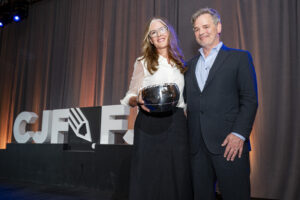
The winners were announced at the CJF Awards ceremony on June 10 at the Royal York Hotel.
CIBC is the Presenting Sponsor of the 2026 CJF Awards.
The 2026 CJF Awards are supported by Google News Initiative, Rogers, Labatt Breweries of Canada, Aritzia, BMO Financial Group, Canada Life, Sobeys, TD Bank Group, Intact, CBC/Radio-Canada, Canadian Medical Association, McCain Foods, Cohere, RBC, Scotiabank, FGS Longview, KPMG, WSP, Canadian Bankers Association, Aga Khan Development Network, AI Safety Foundation, Barry and Laurie Green, CIGI, Canada’s National Observer, CPPIB, Definity Insurance, Fidelity Investments, The Globe and Mail, Loblaw Companies Ltd., Maple Leaf Foods, McDonald’s Canada, The New York Times, OLG, OMERS, Ontario Securities Commission, Real Content Networks, Rishi Nolan Strategies, TD Securities, Uber, Village Media, Weber Shandwick, Zai Mamdani/Mamdani Family Foundation
And in-kind supporters: Bespoke Audio-Visual, Porter, Beehive Design, The Canadian Press
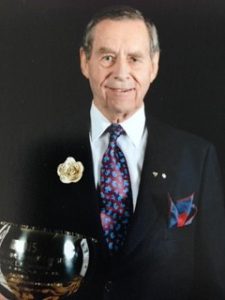 The CJF Dr. Jackman Award for Excellence in Journalism honours a Canadian organization that embodies exemplary journalism with a resulting impact on the community it serves.